Infographics

Apa itu E-Lelong? muaturun
Proses Kerja e-Lelong muaturun
Pesuruhjaya Sumpah dan Syarat-Syarat Pelantikannya muaturun
Bayaran bagi Perkhidmatan Pesuruhjaya Sumpah muaturun
Mewakili Diri Sendiri di dalam Prosiding Jenayah muaturun
Pelaksanaan Sistem e-Appellate muaturun
Sistem Imbasan QR Code Bagi Pengesahan Ketulenan Dokumen Mahkamah di Semenanjung Malaysia muaturun
Carta Alir Tatacara Pengendalian Prosiding Kes Saman Trafik Melalui Teknologi Komunikasi Jarak Jauh muaturun
Prosedur Tuntutan Kecil di Mahkamah muaturun
Prosedur Pengendalian Mediasi muaturun
Prosedur Pengendalian Persidangan Mahkamah Secara Sidang Video bagi Mahkamah Sabah dan Sarawak untuk Pemegang-Pemegang Taruh (Stakeholders) muaturun
Tatacara Operasi Standard Pencegahan Wabak COVID-19 di Mahkamah Seluruh Malaysia Bagi Pengguna muaturun
Scam Alert 1 muaturun
Scam Alert 2 muaturun
Scam Alert 3 muaturun
Scam Alert 4 muaturun
Scam Alert 5 muaturun

Scam Alert 6

muaturun

Scam Alert 7

muaturun

Scam Alert 8

muaturun

Scam Alert 9

muaturun

Pemakaian Pelindung Muka

muaturun

Cara Menggunakan Pelitup Muka Dengan Betul

muaturun
Ikat Jamin muaturun
Mewakli Diri Sendiri Semasa Perbicaraan muaturun

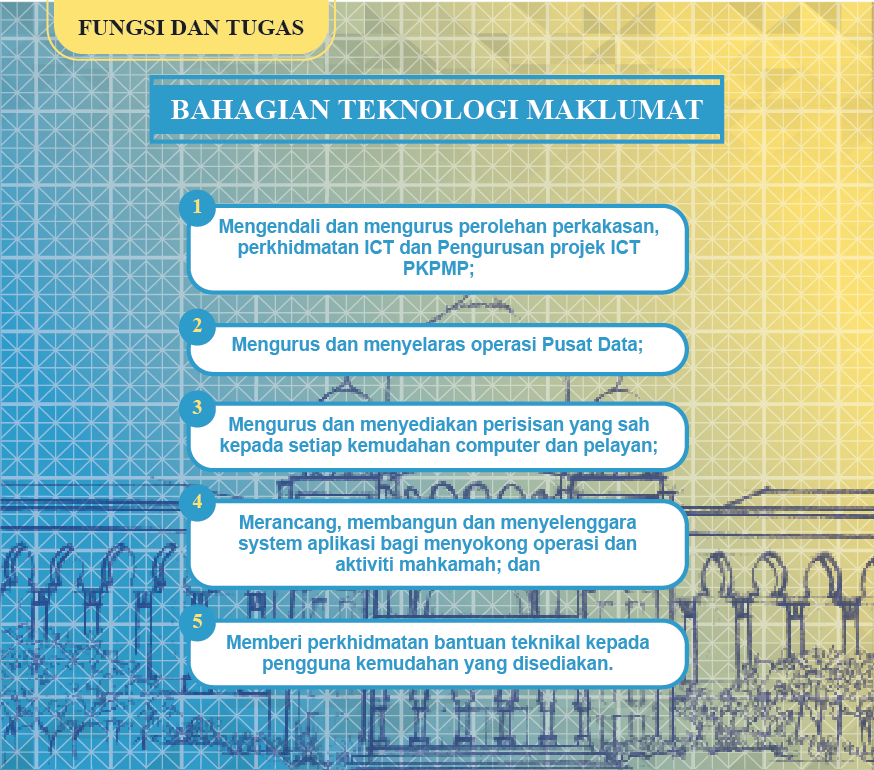
Information Technology Division

INTRODUCTION

The Information Technology Division is responsible to manage the application of the Information Technology for the Chief Registrar’s Office of Federal Court Malaysia. This Division is led by a Director who is assisted by a Deputy Director, several Assistant Directors, and several Information Technology Officers. This Division comprises of several units; Administration & Finance, Asset Unit, Application Unit, e-Mail Unit, e-Court Unit, Network Unit and CRT & Portal Unit. This Division is placed directly under the supervision of the Office of Deputy Chief Registrar II (Operations). This Unit is to perform a vital role in the management and monitoring of networks, applications, hardware, system software and technical services used by all courts throughout Malaysia.

Integrity Unit

INTRODUCTION

Integrity Unit, the Office of Chief Registrar, Federal Court Malaysia is established pursuant to the government’s decision to establish Integrity Unit as a focal point to manage issues in relation to integrity in all government department as stated in Service Circular No. 6 of 2013 (SC6/2013) ‘Establishment of Integrity Unit at all Public Agencies’ with effect from 1 August 2013.

This Unit is led by a Unit Head and assisted by an Administrative & Diplomatic Officer and a senior assistant Registrar. This Unit is directly under the supervision of the Chief Registrar of Federal Court Malaysia.

Judicial History

Aliran Masa

Sejarah Perkembangan Sistem Kehakiman Di Malaysia

  • 1808
    Mahkamah Agung diperkenalkan selaras dengan Piagam Keadilan Pertama (1807)
  • 1826
    Kehakiman berpusat telah dltubuhkan bagi Negeri-Negeri Selat (Pulau Pinang, Melaka, Singapura) di bawah Piagam Keadilan Kedua.
  • 1855
    Piagam Keadilan Ketiga diperkenalkan bagt memisahkan kehakiman berpusat kepada dua bahagian iaitu:
    (i) Pualu Pinang & Melaka
    (ii) Singapura
  • 1868
    Badan Kehakiman dipisahkan daripada badan eksekutif
  • 1878
    Mahkamah bawahan ditubuhkan:
    (i) Mahkamah Majistret
    (ii) Mahkamah Koroner
  • 1921
    Kes rayuan pertama dari Johor dibawa ke Privy Council
  • 1946
    Ordinan Mohkatah dlperkenalkan dan mahkamah bawahan ditukarkan kepada mahkamah rendah
  • 1957
    Kewujudan Perlembagaan Persekutuaan selaras dengan kemerdekaan Persekutuan Tanah Melayu
  • 1963
    Perlembagaan Persekutuan memberi kuasa kepada hakim-hakim, mengekalkan peruntukan-peruntukan bagi rayuan ke Privy Council tetapi tiada perubahan ketara kepada mahkamah rendah.
  • 1964-1993
    Mahkamah Agung digantikan dengan Mahkamah Persekutuan dan tiga Mahkamah Tinggi yang mempunyai bidang kuasa yang sama. Pada tahun 1965, Singapura keluar dari Malaysia dan seterusnya, mengekalkan Mahkamah Tinggi Malaya dan Mahkarnah Tinggi Borneo.
  • 1994
    Perubahan dalam sistem kehakiman moden.
    (i) Sistem tiga lapisan mahkamah diperkenalkan
    (ii) Proses dua lapisan rayuan diwujudkan
    (iii) Gelaran Lord President ditukarkan kepada Chief Justice (Ketua Hakim negara).
    (iv) Sistem perbicaraan melalui juri dan penilai ditamatkan pada tahun 1995

Judiciary Publication

The International Framework For Court Excellence Malaysia muaturun
Carta Alir Tatacara Pengendalian Prosiding Kes Saman Trafik Melalui Teknologi Komunikasi Jarak Jauh muaturun
1. Shipping Law Conference, Arbitration And The Courts, Lord Clarke Of Stone-Cum-Ebony, 15 September 2011 muaturun
2. Ethics And Civil Procedure, Malaysian Judges, Lord Clarke of Stone-cum-Ebony, 14 September 2011 muaturun
1. ‘Malaysia Court Backlog and Delay Reduction Program: A Progress Report’ muaturun
2. Taklimat di dalam "Power Point" : 'Malaysia Court Backlog and Delay Reduction Program" oleh Tun Zaki Tun Azmi, Mantan Ketua Hakim Negara muaturun
3. Laporan Kemajuan Pelan Antirasuah Nasional (NACP) muaturun

Jurisdiction of Court of Appeal

Under Article 121 91B) of the Federal Constitution, the jurisdiction of the Court of Appeal is to determine appeal from the decisions of the High Court in relation to the civil or criminal cases and any other jurisdiction given by or under the federal law.

Jurisdiction of Federal Court

  1. Original Jurisdiction
    • To determine (a) the validity of any law / Imade by Parliament or the Legislature of any states; (b) disputes on any other I Iissue betweenthe Statesor between the / Federation and any State
  1. Appellate Jurisdiction
    • To hear appeals from the Court of Appeal and the High Court
  1. Revisionary Jurisdiction
    • To determine any question arise before another Court as to the effect of any provision under the Federal Constitution
  1. Advisory Jurisdiction
    • The Yang di Pertuan Agong may refer to / the  Federal Court for its opinion or advice as to the effect of any provision of Constitution which has arisen or appears to him likely to arise, and the Federal Court shall pronounce its opinion in open court of any question so referred to it.

Jurisdiction of High Court

Under section 2 of the Court of Judicature Act 1964, the High Court means the High Court of Malaya and the High Court of Sabah and Sarawak. As such, the jurisdiction of the High Court of Malaya is coordinate with the High Court of Sabah and Sarawak.


In general, the High Court of M alaya will hear cases and disputes that rake place in the jurisdiction of the Peninsular Malaysia. Whereas, the High Court of Sabah and Sarawak will hear cases and disputes that take place inits jurisdiction in Sabah and Sarawak only.


Such of the juridsdictions are:

  1. Original Criminal Jurisdiction
    • Hear criminal matters involving death penalty
  2. Original Civil Jurisdiction
    • Hear and determine all civil matters which are beyond the jurisdiction of the Sessions and Magistrates' Court (amount involved is exceeding RM1,000,000.00), and the High Court have the exclusive power to hear a dispute pertaining to the divorce and matrimonial matters; admiralty; bankruptcy and companies' civil disputes; the appointment and guardianship of infant and the property; the appointment and guardianship of the disabled person and the property and letter of administration and probate issues.
  3. Appealate Jurisdiction
    • Hear criminal and civil appeals from the Sessions and Magistrates Courts

Jurisdiction of Session Court and Magistrate Court

Jurisdiction of Sessions Court

  1. Civil Jurisdiction
    • Hear all civil cases such as accident claims, disputes between the landlord and tenant for the value more RM100,000.00 (Ringgit Malaysia One Hundred Thousand only) but not exceeding RM1,000,000.00 (Ringgit Malaysia One Million only).
  2. Criminal Jurisdiction
    • Hear all criminal cases except for the case subject to the death penalty.


Jurisdiction of Magistrate' Court

  1. Civil Jurisdiction
    • The total amount of disputes or claims less than RM100,000.00 (Ringgit Malaysia One Hundred Thousand only).
  2. Criminal Jurisdiction
    • Hear all criminal offenses which subject to fine and imprisonment not exceeding 10 years or fine and may sentence not exceeding five (5) years imprisonment, fine not exceeding RM10,000, and/or 12 times of whipping